
Post Operative Instructions - Feline Spay / Neuter Surgery
is recovering from major surgery and anesthetic, which requires continued support and nursing care at home to ensure a successful outcome. During the recovery period of approximately 14 days, home care is extremely important.
What to expect after surgery
- Drowsiness or increased sleepiness
- Temporary restlessness or increased vocalization
- Mild nausea or decreased appetite
- Delayed bowel movements for 1-2 days
- Mild bruising and discomfort a day after surgery
- Mild cough 2-3 days after surgery from the anesthetic tube causing a small amount of irritation to the throat
- Mild clipper rash at the surgery site
Please keep indoors in a quiet area away from stairs, decks, or other areas where falls or injury could occur. Closely supervise interactions with children and other pets until fully recovered.
IV CATHETER
If had an IV catheter placed, mild bruising or tenderness may occur and should resolve quickly. Shaved areas may also be present from blood draws, monitoring equipment, injections, or other treatments performed during the procedure.
If a bandage is present on the leg, remove it one hour after arriving home. Leaving the bandage in place too long may cause swelling, irritation, or injury to the limb.
Activity
For the first 10 to 14 days following surgery, encourage quiet activity and discourage excessive running, rough play, wrestling with other pets, or repeated jumping whenever possible.
Most cats will continue to jump onto furniture and other household surfaces despite activity restrictions. Occasional jumping is expected and is not typically a concern. However, repeated jumping, high energy activity, or vigorous play may increase swelling and delay healing.
If is especially active, consider temporarily confining them to a smaller room, bedroom, or large kennel when unsupervised to help limit excessive activity during recovery. We can also send home a mild sedatitive if needed. Reach out to the clinic for options.
Incision
Check the incision daily. A small amount of bruising, mild swelling, or redness immediately around the incision can be normal during healing. If the incision opens after hours, minor skin separation can often wait until regular business hours for evaluation. However, significant bleeding, exposed tissue, or tissue protruding from the incision should be treated as an emergency.
Please contact us if you notice:
- Significant redness
- Increasing swelling
- Bleeding
- Discharge
- Foul odor
- Excessive pain or discomfort
- Opening of the incision
For feline spays: It is common for a firm, non-painful swelling approximately the size of a pecan half to develop near the incision during healing. This may appear several days after surgery and typically resolves over 4 to 6 weeks.
CONE OR MEDICAL T-Shirt
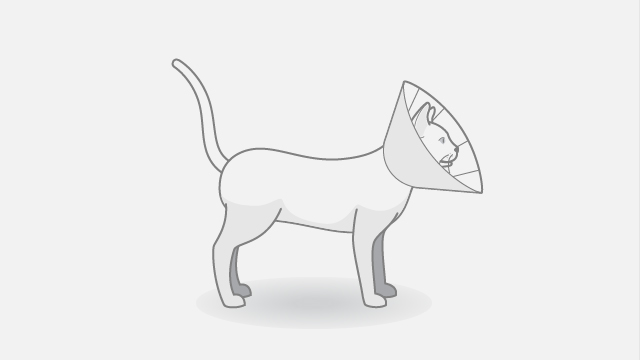
Licking, chewing, or scratching at the incision can result in infection, delayed healing, additional surgery, and additional medical expenses. should wear the provided cone or an approved medical pet t-shirt until the incision is fully healed, typically 12 to 14 days following surgery. Do not bathe or wet the incision for 10-14 days.
Medical Pet Shirts may be appropriate for some patients but are not suitable for all incision locations or pets that persistently lick or chew at the surgical site. They will not cover or protect a male feline neuter incision.
Diet
A general anesthetic can make patients drowsy and nauseous. You may find doesn't want to eat or vomits the night of surgery. Once 's coordination has returned to normal, offer a small amount of food and water. If vomiting occurs after eating or drinking, withhold food and water until the following morning.
Please contact us if:
- Vomiting persists beyond 48 hours
- Appetite does not return within 24 to 48 hours
Long term, your pet will require fewer calories as it adapts to its lowered metabolism. A good rule of thumb is to reduce the food by 30%. For a tailored nutritional plan, contact our friendly team.
medications
If is not vomiting, prescribed medications may be started the evening of surgery. If nausea or vomiting occurs, wait until the following morning before administering medications. Please all medication labels carefully and ensure that all medication is administered as instructed. If you are experiencing any difficulty in dosing your pet, please contact us for advice.
When to call us:
Please contact our office if you notice any of the following:
- Excessive licking or chewing of the incision
- Redness, swelling, discharge, or odor from the incision
- Difficulty urinating or defecating
- Persistent vomiting
- Refusal to eat after 24 hours
- Pale gums
- Significant lethargy
- Any concern that your pet is not recovering normally
emergency services
Emergency services are available after hours at the following locations. You are responsible for any fees charged by other clinics.
- MedVet Salt Lake City - 331 W Bearcat Dr, Salt Lake City, UT 84115 - 385-341-4444
- Advanced Veterinary Care - 1021 E. 3300 S, Salt Lake City, UT 84106 - 801-515-2023
- Cottonwood Animal Hospital - 6360 Highland Dr, Murray, UT 84121 - 801-278-0505
- Mountain West Veterinary Hospital - 13860 South 2700 West, Bluffdale, UT 84065 - 801-515-5011
- Mountain West Veterinary Hospital - 908 Main St, Layton, UT 84041 - 801-683-6201
Owners are responsible for following all post-operative instructions and medication directions provided at discharge. Failure to follow these instructions may result in complications or delayed healing. Any additional medical, surgical, or emergency care required after discharge, including treatment related to post-operative complications, will remain the financial responsibility of the owner.